
What the studies actually tested
Most research on adult coloring follows the same design: participants complete an anxiety or mood questionnaire, do a short activity (coloring a mandala, coloring a free drawing, or a control task such as reading or free drawing on blank paper), then complete the questionnaire again. The studies are small, usually between 40 and 120 people, and mostly university students. That is worth keeping in mind: the evidence is consistent but not large.
Curry and Kasser (2005): structured coloring lowers anxiety
The study most often cited is by Nancy Curry and Tim Kasser, published in Art Therapy: Journal of the American Art Therapy Association in 2005, titled "Can Coloring Mandalas Reduce Anxiety?". After inducing mild anxiety, participants either colored a mandala, colored a plaid pattern, or drew freely on a blank page. Both structured coloring conditions reduced anxiety more than free drawing. The authors suggested that the structure of a predefined design is part of what makes coloring calming: you do not have to decide what to make, only how to fill it.
Flett and colleagues (2017): a week of daily coloring
Jayde Flett and colleagues at the University of Otago published "Sharpen Your Pencils: Preliminary Evidence that Adult Coloring Reduces Depressive Symptoms and Anxiety" in Creativity Research Journal in 2017. Participants were assigned to a week of daily coloring or a week of daily logic puzzles. The coloring group reported lower depressive symptoms and anxiety at the end of the week; the puzzle group did not show the same change. Because the comparison activity was also calm and absorbing, this study is a useful hint that coloring is not simply "any quiet activity".
Eaton and Tieber (2017): choosing your own colors matters
Judith Eaton and Christine Tieber, in "The Effects of Coloring on Anxiety, Mood, and Perseverance" (Art Therapy, 2017), compared coloring a mandala with free choice of colors against coloring the same mandala with assigned colors. Free-choice coloring produced larger reductions in anxiety and greater improvement in mood. The practical takeaway is simple: coloring relaxes you more when you make the small decisions yourself, which is exactly what a coloring book lets you do.
Mantzios and Giannou (2018): coloring versus mindfulness instructions
Michail Mantzios and Kyriaki Giannou asked "When Did Coloring Books Become Mindful?" in Frontiers in Psychology (2018). They compared free coloring, coloring a mandala, and coloring with explicit mindfulness guidance. Coloring reduced anxiety in the short term across conditions, but adding mindfulness instructions did not add much on its own. In other words, the calming effect seems to come from the activity itself rather than from the label "mindful coloring" on the cover.
Holt and colleagues (2019): attention and mood in the lab
Nicola Holt and colleagues published "Cognitive and Affective Benefits of Coloring: Two Randomized Controlled Crossover Studies" in Art Therapy in 2019. Participants colored, drew freely, or read. Coloring improved mood and was associated with a calmer, more focused state than reading, and it did so without the self-judgment that free drawing can bring ("I can't draw"). That last point explains why coloring reaches people who would never pick up a sketchbook.
So why does it work? The plausible mechanisms
- Narrow attention. A small shape and a single color give your attention a concrete target. Worry needs free attention to run; coloring takes it up.
- Repetitive motor action. Back-and-forth strokes are rhythmic and predictable, similar to knitting or walking, which many people find soothing.
- Low stakes. There is no blank page and no right answer. You cannot fail a coloring page, which removes the performance pressure that makes other creative activities stressful for beginners.
- A visible result. Finishing a page in one sitting gives a small, real sense of completion, something most workdays do not.
What the research does not say
Coloring is not art therapy, which is a clinical practice delivered by trained therapists, and none of these studies claim it treats an anxiety disorder or depression. The effects measured are short-term changes in state anxiety and mood after a session, not lasting changes in mental health. If you are struggling, coloring is a fine daily habit to keep, but it is a complement to professional support, not a substitute.
How to get the most out of it
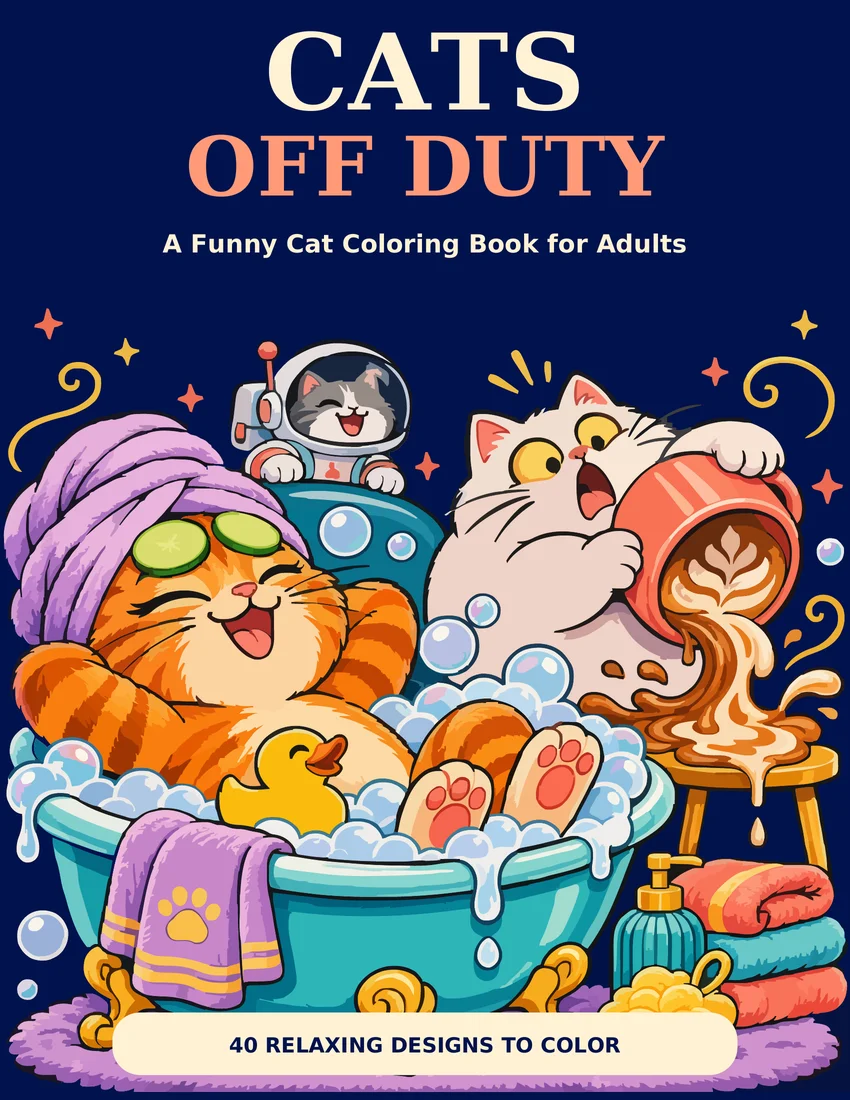
Based on the studies above and on what regular colorers report, a few things help. Pick structured designs with clear outlines rather than blank pages. Choose your own colors. Keep sessions short and regular, 15 to 30 minutes, rather than occasional marathons. And choose a theme that puts you in a good mood before you start; humor helps, which is why we made a book of cats off duty and a club of very relaxed capybaras rather than another set of abstract patterns. If you are deciding between books, our guide to choosing a coloring book for stress relief covers the practical details.
Sources
- Curry, N. A., & Kasser, T. (2005). Can Coloring Mandalas Reduce Anxiety? Art Therapy: Journal of the American Art Therapy Association, 22(2).
- Flett, J. A. M., Lie, C., Riordan, B. C., Thompson, L. M., Conner, T. S., & Hayne, H. (2017). Sharpen Your Pencils: Preliminary Evidence that Adult Coloring Reduces Depressive Symptoms and Anxiety. Creativity Research Journal, 29(4).
- Eaton, J., & Tieber, C. (2017). The Effects of Coloring on Anxiety, Mood, and Perseverance. Art Therapy, 34(1).
- Mantzios, M., & Giannou, K. (2018). When Did Coloring Books Become Mindful? Exploring the Effectiveness of a Novel Method of Mindfulness-Guided Instructions for Coloring Books to Increase Mindfulness and Decrease Anxiety. Frontiers in Psychology, 9.
- Holt, N. J., Furbert, L., & Sweetingham, E. (2019). Cognitive and Affective Benefits of Coloring: Two Randomized Controlled Crossover Studies. Art Therapy, 36(4).
Written by
Ferova
A small design and software studio in Bogotá, Colombia. We draw and publish adult coloring books on Amazon KDP and proof every page with real markers before it goes live. About the studio